Answers that know who’s asking.
A studio concept for a company-owned assistant that answers from internal documents, shows its sources and uses only what the person asking can already open.
The problem.
People at a growing company lose time hunting for the right policy, price list or process. Many paste internal documents into personal AI tools to get an answer faster.
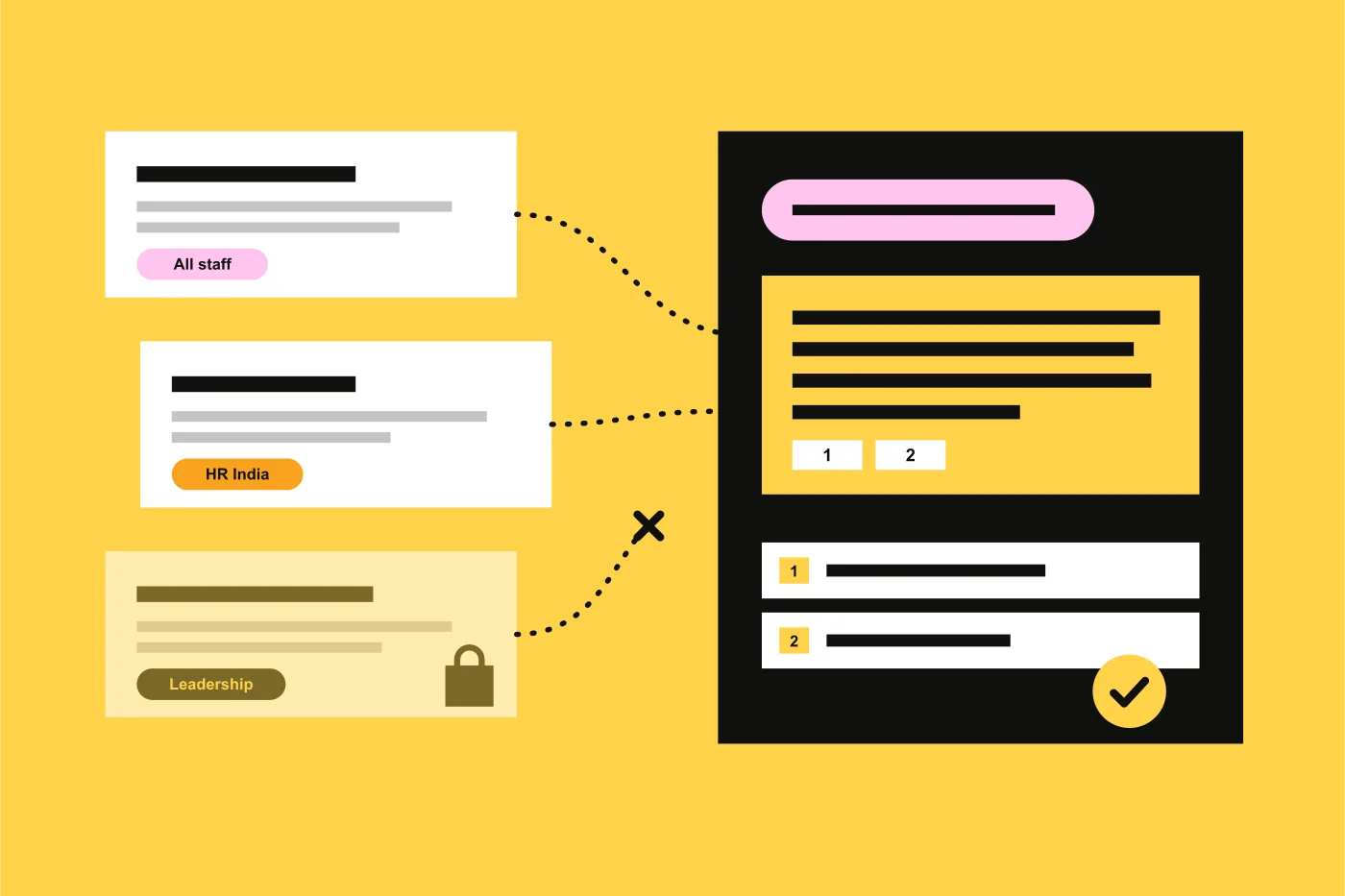
A company-owned assistant can answer from approved sources instead. The hard part isn’t the chat window. It’s making sure each answer respects who may see what, and that people can check where the answer came from.
Same question.
Different access.
Pick an employee and a question. The answer and its sources change with what that person can open.
Employee
Question
Simulated in your browser with a fictional company, Harbourline Group, and prepared answers. No AI model, company data or account is connected.
Priya asks
How much parental leave do we offer in India?
The global policy gives at least 16 weeks’ paid leave to the primary carer. The India addendum sets the local entitlement and how to apply, and says the more generous of the two applies.
Sources used
- Global leave policy 2026All staff
- India leave addendumHR India
Demo view: the access check
Priya is in All staff and HR India, so can open 2 of 2 relevant documents.
Shown here to explain the idea. An employee wouldn’t see which documents were left out.
How it would
be built.
The proposed architecture. Nothing here is running yet; a real build starts with the company’s own systems, contracts and security team.
Connect the sources
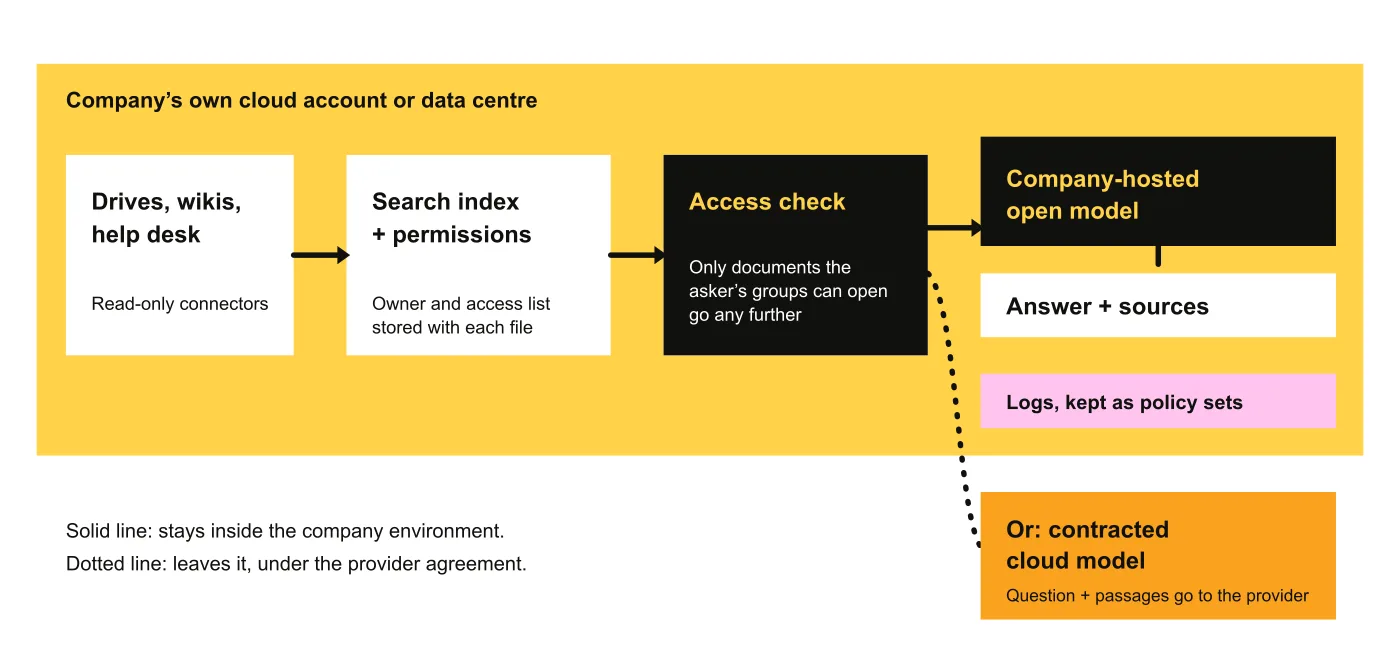
Read-only connectors for the drives, wikis and help-desk tools the company chooses. Each document is indexed together with its owner and its permission list.
Keep the index in the company’s account
The search index and conversation records run in the company’s own cloud account or data centre, in the region it chooses.
Check access before the model reads anything
Each question is matched only against documents the asker’s groups can open. Only those passages are passed to the model.
Answer with sources
Every answer links to the documents it used. When nothing suitable is found, the assistant says so rather than guessing.
Choose the model
An open-weight model on company-managed servers keeps prompts inside that environment. A contracted cloud model is quicker to start, but prompts and the retrieved passages are sent to that provider under the company’s agreement.
Where it can
go wrong.
- The assistant is only as careful as the permissions behind it. If a folder is shared with everyone, the assistant can quote it to everyone, so a permissions review comes before launch.
- Documents can contain text written to manipulate an AI. In this design, retrieved text is treated as information, not instructions, and the assistant can’t change files or send messages.
- Answers can still be wrong. Showing sources lets people check, and a feedback button sends doubtful answers to the document owner.
Getting people
to use it.
Adoption is planned like a product launch, one team at a time.
Pilot
One department, one cleaned-up set of sources and the questions people ask every week.
Measure
How often people open a cited source, which questions get no answer (gaps in the documentation) and what the help desk stops being asked.
Expand
Add sources one owner at a time, each with a permissions check, and give every source a named person who keeps it current.
Research behind it.
External references. These are other people’s projects and publications, linked for reading; they are not Sociopup work or endorsements.
- Onyx, open-source AI platform (GitHub)
Its README describes indexing documents together with their permissions, self-hosted and air-gappable deployment, and support for both self-hosted and commercial models. Community Edition is MIT-licensed.
- Microsoft Learn: Data, privacy and security for Microsoft Copilot
States that Copilot only surfaces organisational data a user has at least view permission for, and stresses getting those permissions right. Read on 30 October 2026.
- OWASP Top 10 for LLM Applications 2025
Prompt injection, sensitive information disclosure and vector and embedding weaknesses shaped the limits above.
Make it yours.
This is a studio concept with a simulated demo, not a delivered project or a product for sale. If your company wants something like it, we start with a discovery of your systems, data rules and contracts, with your IT and security people involved.
Talk about private AI