AI for every team, on company terms.
A studio concept for one company AI workspace: approved models, shared workflows and sensible limits. Employees get real freedom for everyday work, without moving company data into personal accounts.
The problem.
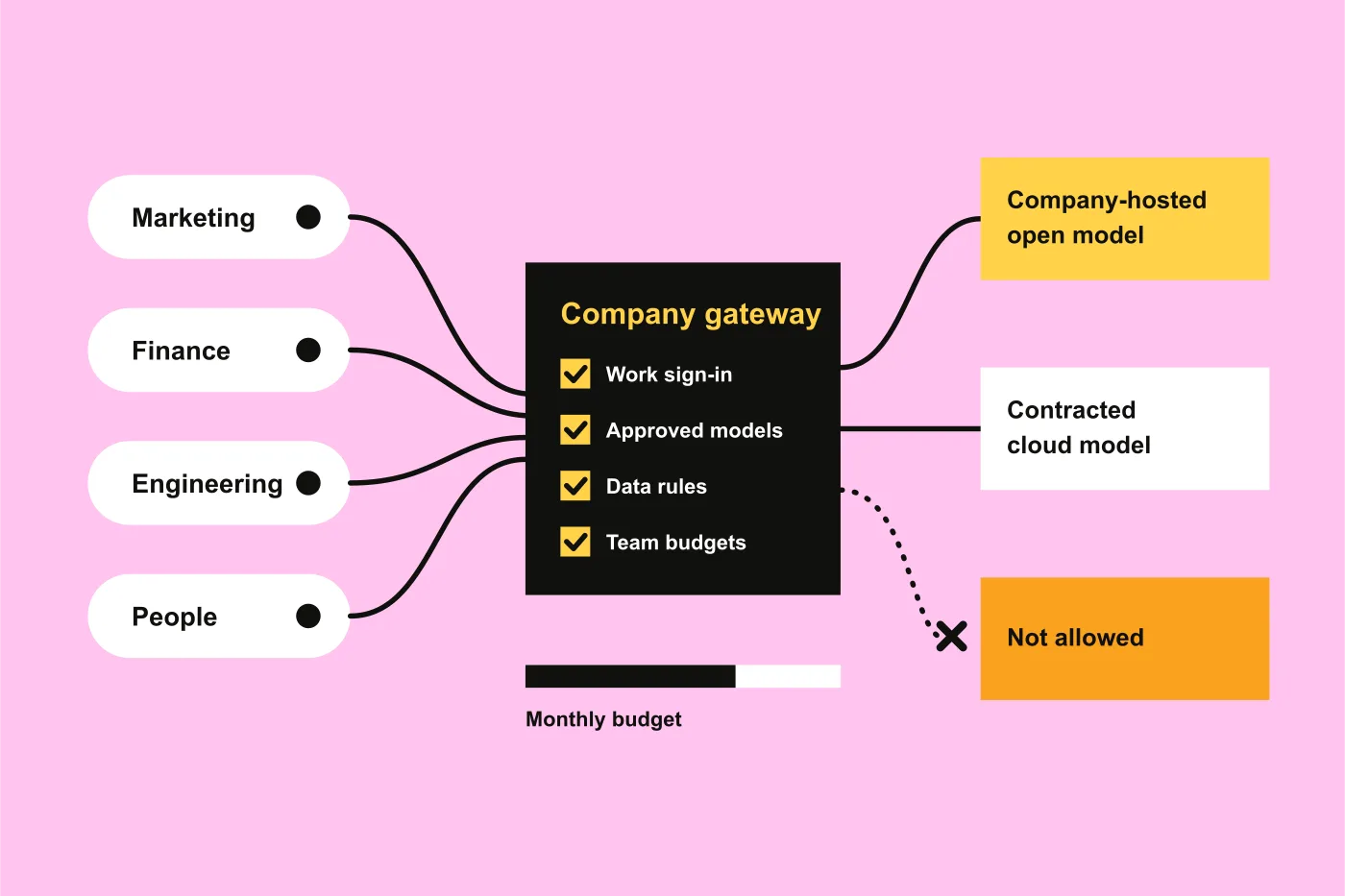
Banning AI rarely stops people using it. It moves the work into personal accounts the company can’t see, support or switch off when someone leaves.
The alternative is a workspace the company runs. Staff sign in with their work account, choose from approved models and reuse prompts that already work. The rules follow the data, not a policy PDF nobody reads.
Freedom, with
a few clear rules.
Choose a team, a task and the kind of information involved. See which model is allowed, the rule behind it and what gets recorded.
Team
Task
Information involved
Simulated with a fictional company, Harbourline Group, and prepared rules. No model, gateway or account is connected, and the budgets are sample numbers.
Allowed route
Contracted cloud model
Internal material may use the cloud model covered by the company’s agreement, which should set how long prompts are kept and rule out training on them.
- Workflow
- Team template: first draft in the brand voice
- Recorded
- Who used it, which model, the cost and the data type.
- Marketing budget this month
- $410 of $600 left
How it would
be built.
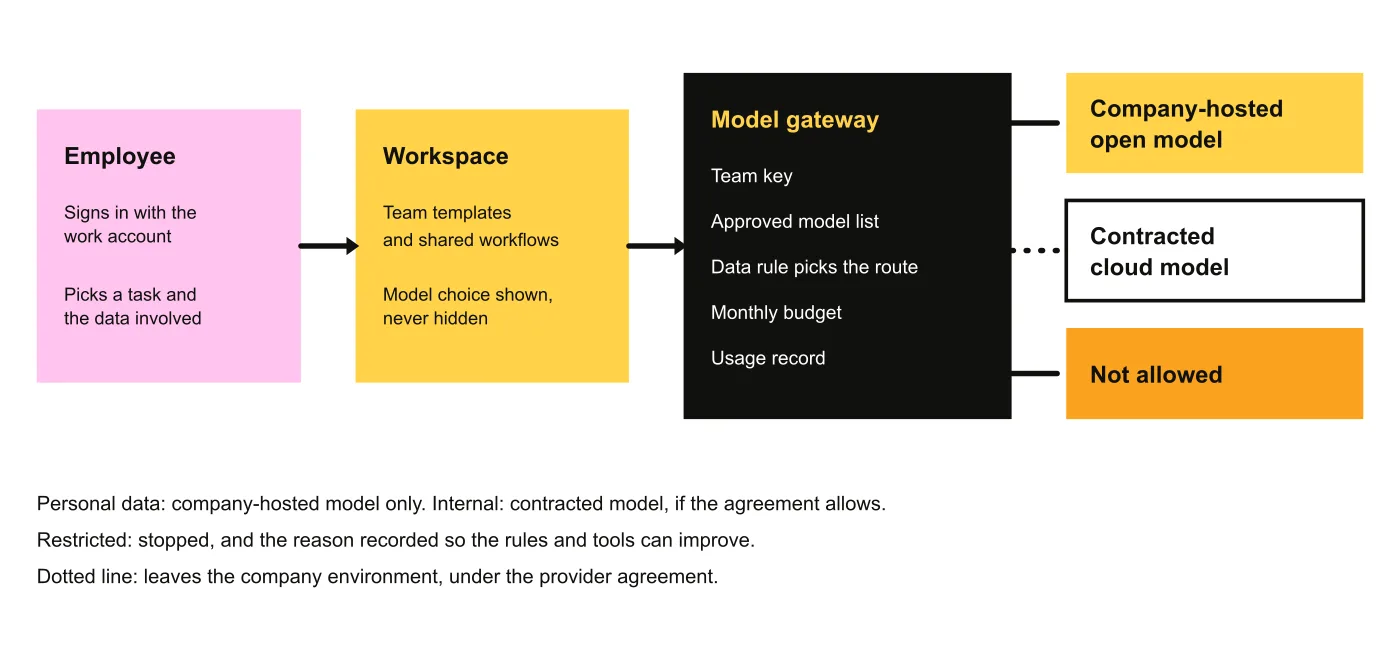
The proposed architecture. Nothing here is running yet; a real build starts with the company’s own systems, contracts and security team.
Sign in with the work account
Single sign-on through the company’s identity provider. When someone leaves, their access goes with their account.
One gateway in front of every model
A model gateway gives each team its own key, checks which models that team may use, applies a monthly budget and records usage.
Rules follow the data
People choose the kind of information they’re working with, and the rule picks the model route. Automatic detection can help, but the choice stays visible to the person.
Model choice without lock-in
Open-weight models on company-managed servers for sensitive work; contracted cloud models where the agreement allows. Providers can change behind the gateway without retraining staff.
Shared workflows
Prompts and small workflows that work are saved to a team library, each with an owner who keeps it current.
Where it can
go wrong.
- Self-hosting a model keeps prompts on company-managed servers, but it brings running costs, capacity planning and security updates the company must own.
- A contracted cloud model is governed by the provider’s terms for the company’s plan. Those terms, the data region and retention settings need checking before anything sensitive is allowed.
- Budgets and rate limits stop runaway costs, and code helpers here can suggest changes but can’t deploy them.
Getting people
to use it.
Adoption is planned like a product launch, one team at a time.
Pilot
Two or three teams with clear everyday tasks, a short list of approved models and a few shared templates.
Expand
Team champions publish workflows that work. Blocked requests are reviewed monthly, because they show where the rules or tools fall short.
Scale
New teams join within the same rules. A regular review covers who governs it, the risks mapped, what is measured and how issues are managed.
Research behind it.
External references. These are other people’s projects and publications, linked for reading; they are not Sociopup work or endorsements.
- LiteLLM, open-source AI gateway (GitHub)
A gateway for 100+ model providers with virtual keys, spend tracking per project or user, logging and guardrails.
- LiteLLM documentation: virtual keys
Describes per-key model lists, automatic spend tracking per key and key budgets.
- Open WebUI (GitHub)
A self-hosted AI platform that works with Ollama and OpenAI-compatible APIs, with roles, groups and permissions, LDAP and SSO. Its licence includes a requirement to keep Open WebUI branding.
- NIST AI Risk Management Framework
AI RMF 1.0 (January 2023) and its Generative AI Profile, NIST AI 600-1 (July 2024). The rollout stages follow its four functions: govern, map, measure, manage.
- OWASP Top 10 for LLM Applications 2025
Excessive agency and unbounded consumption informed the limits on code helpers and budgets.
Make it yours.
This is a studio concept with a simulated demo, not a delivered project or a product for sale. If your company wants something like it, we start with a discovery of your systems, data rules and contracts, with your IT and security people involved.
Talk about private AI